
Choosing software
How to choose medical billing software in South Africa
Most software comparisons are feature lists, and feature lists are close to useless here. Every product in this market will tell you it does claims, billing, patients and reports. What separates them is how they behave on the day a claim is rejected, and what happens to your money and your data in the year after you sign.
Six things worth checking, roughly in order of how much they cost you if you get them wrong.
1. Does it submit in real time, and does it show you the verdict?
This is the one that moves money. Software that batches claims and tells you the outcome days later means every rejection is discovered after the fact, and a corrected claim then waits for the next payment run. One unnoticed rejection can add a month to getting paid.
Ask to see it. On the demo, have them submit a claim and show you the scheme's response arriving. Then ask what a rejection looks like on screen and how you fix it. If the answer is a report you check later, you have your answer. There is more on the arithmetic in real-time versus batch submission.
2. Which pricing model, and how does it behave as you grow?
Three models dominate, and they diverge sharply at the edges rather than in the middle.
- Percentage of collections. Nothing up front, but the cost rises with your turnover, so a good month is an expensive month.
- Monthly subscription, often per user. Predictable, and it charges you the same in December as in a full month. It also charges you for staff rather than for work.
- Flat fee per claim. Tracks your actual volume, so a quiet month is a cheap month, and adding a receptionist costs nothing.
None is universally right. Run all three against your own last three months rather than against a hypothetical practice. The maths for each model is here. For the record, we charge R9.50 a claim with the first 10 each month free, which suits low and variable volumes and is less compelling if you are enormous and steady.
3. Does it know your discipline's tariff codes?
This one is invisible on a demo and expensive afterwards. South African tariff codes come in two billed forms: medical specialists bill the bare four-digit code, and allied and paramedical disciplines bill their BHF discipline number followed by the procedure. A physiotherapist bills 72303, not 0303.
Software that does not handle your form produces rejections across the board rather than case by case, and it looks like a pricing or connectivity problem rather than a coding one. If you are physio, OT, dietetics, psychology, podiatry, audiology, biokinetics or nursing, ask the question explicitly. Here is what it looks like for physiotherapy.
4. Who owns your data, and can you leave?
Ask for the export format before you sign, not after. You want your patient list, visit history and outstanding balances in a form something else can read. A vendor who cannot answer this quickly is telling you something.
This matters more in healthcare than in most software, because you have retention obligations for clinical records that outlast any contract. Under POPIA you also remain responsible for patient information the vendor processes on your behalf, so understanding where it lives is not optional.
5. What is the contract, really?
Minimum term, notice period, and what happens to your data at the end of it. Annual contracts are not automatically bad, but a twelve-month commitment to software you have used for a week is a poor trade when the alternative exists. If there is a setup fee, ask what it buys.
6. Is support a person, in this country, in your hours?
Unglamorous and the thing you will care about most. A claim stuck at a scheme is money not arriving, and the difference between someone answering and a ticket queue is measured in payment runs. Ask what happens if you phone at 16:00 on a Friday. Ask who you are actually speaking to.
Where we are the wrong choice
Worth saying plainly, because every vendor page pretends otherwise.
- You are outside South Africa. Everything that makes this work is South African: the scheme connections, the tariff structures, the ICD-10 requirements. It will not help you elsewhere.
- You want a full clinical EMR. We do notes, scripts, referrals and sick notes well. If your requirement is deep specialty-specific clinical workflow, templating and decision support, that is a different category of product.
- You want someone else to do the billing. This is software your practice operates. If nobody there has the time or inclination, a bureau is a better fit and we would rather say so than sell you a tool that sits unused.
- You are very high volume and want a fixed cost. Per-claim pricing scales linearly. Past a certain point a negotiated flat arrangement may work out better, and that is worth a conversation rather than an assumption.
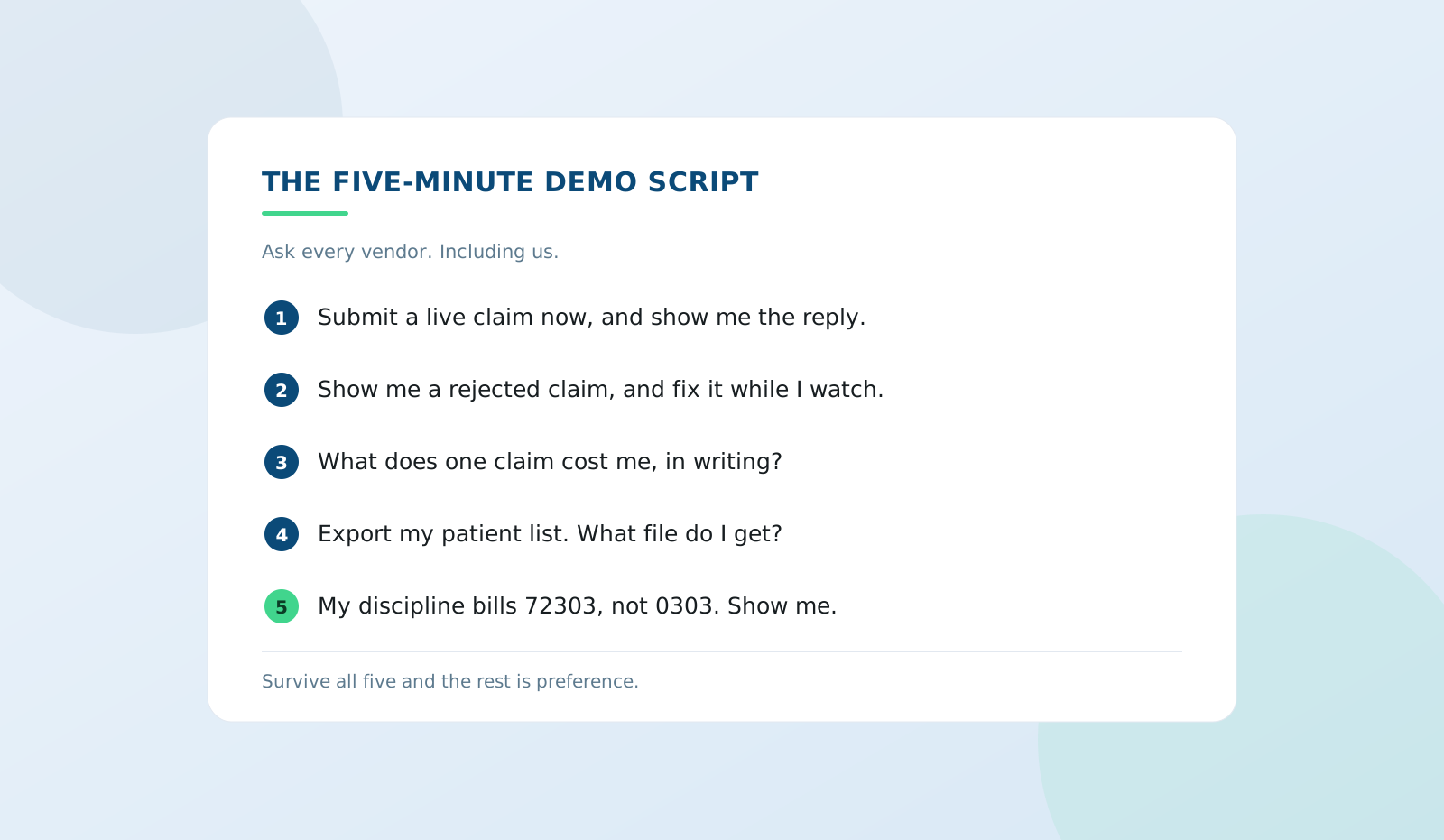
The five-minute demo script
Take this to every vendor you speak to, including us. If a product survives all five, the rest is preference.
- Submit a real claim now and show me the scheme's response on screen.
- Show me a rejected claim and fix it while I watch.
- What does one claim cost me, in writing, including anything per-scheme or per-transaction?
- Export my patient list and history. What file do I get?
- My discipline bills the {BHF}NNN code form. Show me a claim going out with it.
Frequently asked questions
How long does it take to switch?
Setting up new software is fast. Moving a live practice onto it is the real work, mostly because of open claims and outstanding balances mid-flight. We wrote up how to sequence it.
Do I need separate accounting software as well?
Usually yes. Billing software runs the claim and patient side; your accountant will still want a general ledger. What you want is clean figures flowing between the two rather than one product pretending to be both.
Is the cheapest option ever the right one?
Sometimes, at low volume. But the cost that matters is not the fee, it is the claims you lose. One rejected claim a month that nobody catches usually outweighs the entire difference between the options you are comparing.
Run the demo script on us first. Create a free account and submit a real claim - the first 10 each month are free →