
Running a practice · Billing
Medical Billing for a Small Practice: What You Need, and What It Should Cost
Most medical billing software is designed for a practice with a front desk. There is a receptionist capturing patients, a billing clerk running month-end, and a practice manager reading reports. A solo physiotherapist, a psychologist in private rooms, or a two-dietitian practice has none of those people. The practitioner is the billing department, usually at 7pm.
That changes what matters. A small practice does not need more features; it needs fewer steps, and a price that does not assume a big practice's turnover. Here is what to insist on, what you can safely skip, and what it should cost.
What a small practice actually needs
1. Claims to every scheme you bill, electronically
This is the non-negotiable. If the software cannot submit to a scheme your patients belong to, you are back to paper or to the patient claiming for themselves, which is slower for everyone. Ask which schemes it submits to directly, not whether it "supports medical aid".
2. The scheme's answer the same day
For a small practice this matters more than anything else on the list. You do not have a clerk who reads responses tomorrow. If a claim is rejected for a wrong dependant code, the cheapest time to fix it is while the patient's file is still open, and a correction made the same day can usually be reversed and resent electronically. Days later it often cannot. Real-time versus batch submission sets out the cash-flow difference.
3. Codes checked before you send
Rejections for category-header ICD-10 codes, the wrong tariff code form for your discipline, or a missing cause code on an injury are the classic small-practice losses, because there is nobody to double-check. Good software picks codes from a maintained list and flags the structural mistakes before the claim goes. Medical aid claim codes explained covers the traps.
4. Patient balances that are easy to collect
Scheme shortfalls, co-payments and claims paid to the member all become money the patient owes you. You need to see who owes what, send a statement and record a payment without a spreadsheet on the side.
5. Nothing to install, usable on a phone
If you work between rooms, a hospital or home visits, capturing the claim on a phone at the point of care is what stops the evening backlog forming in the first place.
What you can safely skip
- Multi-branch, multi-user dashboards. Useful at twenty practitioners; clutter at one.
- A long contract. A small practice's volume changes: a new room, a quiet December, a second practitioner. Month to month is the right shape.
- Paying for a bureau's full service when you only need the software. A billing bureau earns a percentage of your turnover for doing the work for you. That is worth it if you want billing off your plate entirely. It is expensive if what you actually needed was a tool that makes the work take a minute. What medical billing costs does the maths on commission against per-claim pricing.
What it should cost
For a small practice, the shape of the price matters more than the headline number. A fixed monthly subscription is predictable, but at low volume it can cost more per claim than a busy practice pays, because you are paying the same fee for a fraction of the claims. A per-claim price rises and falls with your work.
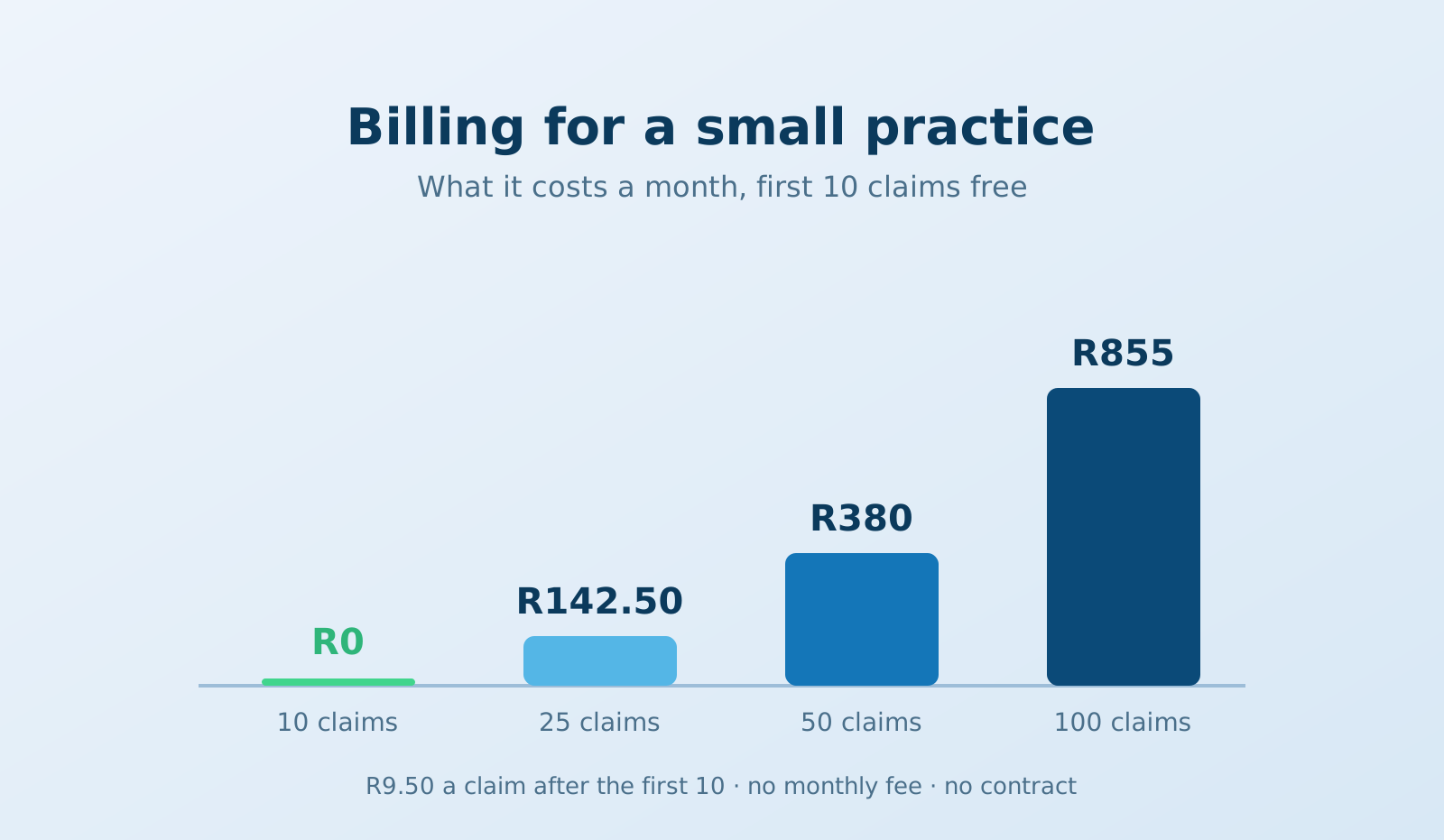
NetPractice charges per claim, with a free allowance. The first 10 claims every month are free, on the full product, and every claim after that is R9.50. There is no monthly fee, no setup fee and no contract.
| Claims in a month | Free | Charged | Monthly cost |
|---|---|---|---|
| 10 or fewer | all | 0 | R0 |
| 25 | 10 | 15 × R9.50 | R142.50 |
| 50 | 10 | 40 × R9.50 | R380 |
| 100 | 10 | 90 × R9.50 | R855 |
If you are just starting out, the free allowance means your first quiet months cost nothing while the practice builds. Starting a private practice covers the practice number and scheme setup that come before the first claim. The pricing page has more worked examples.
A realistic routine for one person
- Capture the claim at the end of each consultation, not at the end of the week. It takes a minute or two with the file still open.
- Glance at responses before you close for the day. Fix anything rejected now, while it is still reversible and the details are fresh.
- Once a week, reconcile what was paid against what was accepted. That is where shortfalls and paid-to-member claims show up.
- Once a month, send patient statements for anything outstanding.
That is the whole job. The practices that struggle with billing are rarely the ones with the wrong software; they are the ones where claims pile up for a week and every rejection is found too late to fix cheaply.
Frequently asked questions
Is free medical billing software good enough for a small practice?
It depends what "free" means. Is there free medical billing software in South Africa? explains why submitting to schemes usually costs money somewhere, and what to check before you trust a free offer.
Will it work for my discipline?
Allied disciplines bill tariff codes in a different form from medical specialists, so ask. NetPractice has pages for physiotherapy, psychology, dietetics and other disciplines explaining how each bills.
What if I grow?
Per-claim pricing grows with you, and adding a practitioner or a second user should not mean changing systems. Check that before you start, not after.
Built for the practice where the practitioner is also the billing department. Your first 10 claims every month are free, then R9.50 a claim, with no monthly fee. Start claiming with NetPractice →