
Claims · Getting paid
"Paid to Member": How to Collect Money a Medical Scheme Paid to Your Patient
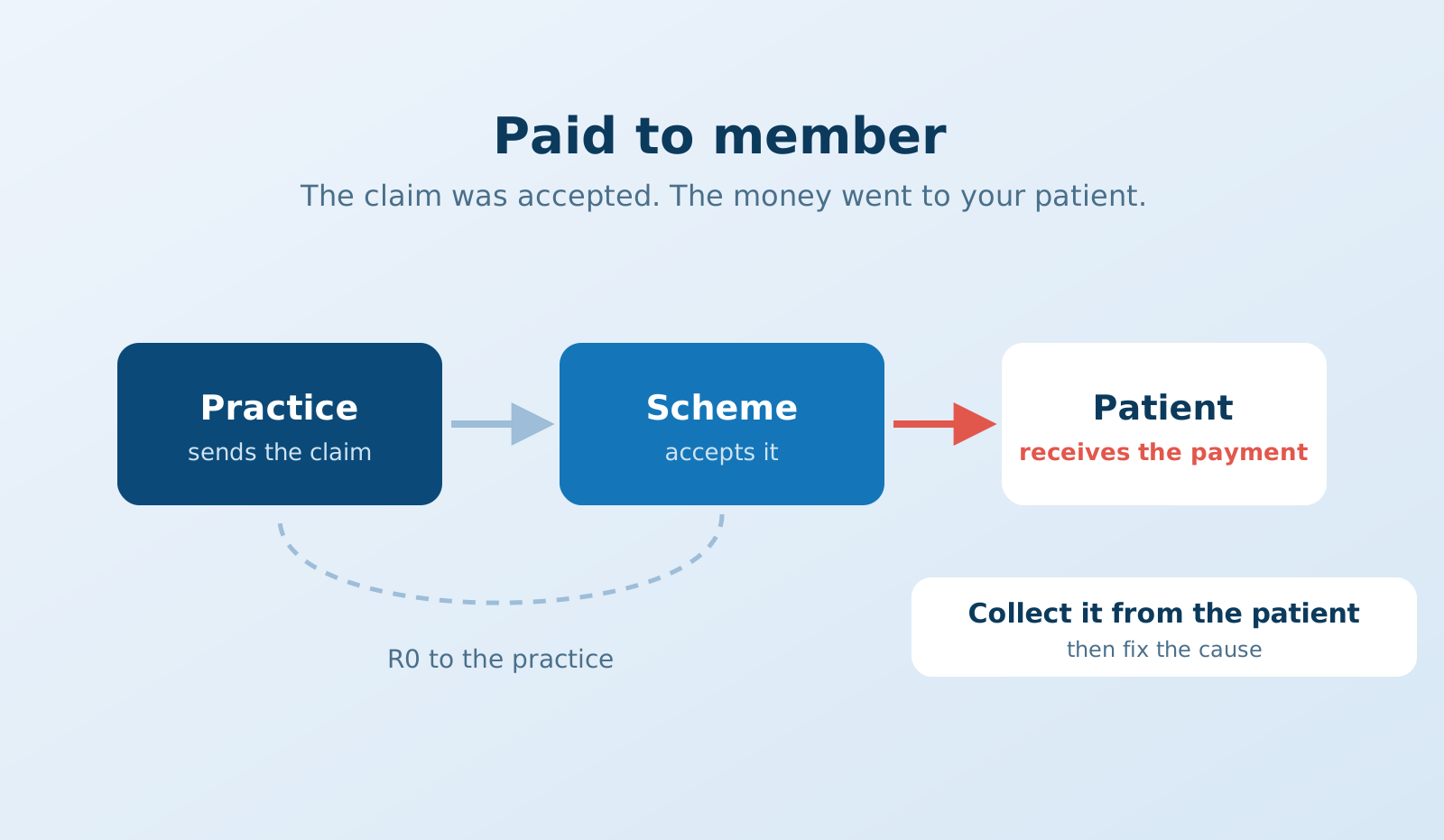
The claim was accepted. The codes were right, the patient had benefit, the scheme agreed to pay. And none of it arrives. Look closely at the remittance and the line reads paid to member: the scheme settled the claim with your patient instead of with you.
This is not a rejection, and treating it like one wastes time. Nothing is wrong with the claim, so there is nothing to fix and resend. The money exists; it is in your patient's bank account. The job now is collection, and then making sure it does not keep happening.
How to spot it
Paid-to-member lines are easy to miss because they do not look like failures. On a remittance advice or in the scheme's electronic response, the line is accepted, often with the full scheme amount shown, but the amount paid to the provider is zero and the claim is marked as paid to the member or the principal member.
Two checks catch them reliably:
- Reconcile paid against accepted, not just rejected. A practice that only chases rejections will never see these, because they are not rejections.
- Watch for a pattern on one code or one scheme. A single redirected claim can be a one-off. The same code redirected across several patients is almost always a cause you can fix.
Why it is worth taking seriously
Across 180 days of claims we process, 5,301 claim lines across 210 practices, carrying R3.4 million of billed value, were paid to the member. On every one of those lines the practice received nothing directly from the scheme. Not a reduced amount - nothing. Every rand of it has to be collected from patients, one conversation at a time.
Collecting it from the patient
The patient owes you the account, and the scheme has given them the money to pay it. Most patients pay once they understand that. The difficulty is usually that they do not know it happened.
- Move fast. The best time to collect is within days of the scheme's payment, while the money is still identifiably "the medical aid refund" and not already spent.
- Send a statement that shows the scheme's decision. Show the date of service, what was claimed, and that the scheme paid the member on that date. A patient argues with a practice's number; they rarely argue with their own scheme's.
- Say it plainly. Something like: "Your medical aid paid this claim to you rather than to us on 14 October. Please pay the amount over to the practice." Most people have simply not noticed.
- Make paying easy. Banking details and the reference on the statement, and the option to pay at the next visit.
- Record the payment against the visit so the account balances and the patient is not chased again for something already settled.
- Follow up on a set rhythm - a reminder a week later, then at the next appointment. Consistency matters more than tone.
For repeat patients, the next booking is your best lever: settle the outstanding amount before or at the next visit, and explain why so it does not feel arbitrary.
Why resubmitting does not fix it
The natural instinct is to correct the claim and send it again. That usually does not help. The scheme has already decided and paid that claim, so a corrected resubmission does not pull the money back from the patient and send it to you. At best it is refused as a duplicate. Scheme payment runs have moved on; the patient is now the route to the money.
What is worth fixing is the cause, so the next hundred claims pay to you.
Stopping it recurring
In the claims we process, the most common cause by far is price: a billed amount above the scheme's rate for that code. It is a cliff, not a slope. Being a few percent over the rate does not cost you a few percent; the whole line is paid to the member. Where price explained the redirect, the practices we looked at were typically only 3% to 14% over. That is not aggressive overcharging, it is a pricelist that drifted after a rate change.
- Take the rate from a line the scheme paid you, on your own remittance - not from a rate card you were once sent.
- Check the codes you bill most, not the expensive ones. Volume multiplied by the whole line value is where the money goes.
- Recheck after every scheme rate change, which for most schemes means every January.
Our free scheme rate checker does the comparison for you: paste the code, your price and what the scheme allowed, and it shows how far over you are. It runs in your browser and sends nothing anywhere.
If your price is at or below the rate and claims are still being paid to the member, the cause is usually attached to the provider rather than the line - something about how the practice is set up on the scheme's side. That is a conversation to have with the scheme directly, and worth having soon, because it will affect every claim.
Frequently asked questions
Is it legal for the scheme to pay the patient instead of me?
Schemes have discretion over whom they pay and the scheme's rules set out when they will pay the member. Whatever the reason, the patient still owes the account for the service you provided, so the debt is collectable.
Should I charge the patient the full account or only the scheme amount?
The full account. The scheme amount is now in the patient's hands, and any difference between that and your fee was always the patient's portion. The statement should show both clearly.
What if the patient has already spent it?
Then it is an ordinary outstanding account. Agree a payment arrangement rather than letting it drift - a small monthly amount collected is worth more than a large balance that is written off.
See paid-to-member claims the moment the scheme responds, send the patient a statement, and record the payment against the visit. See how NetPractice handles medical aid claims →
Free under 11 claims a month. Start claiming →