
Claims · Rejections
How to Fix and Resubmit a Rejected Medical Aid Claim
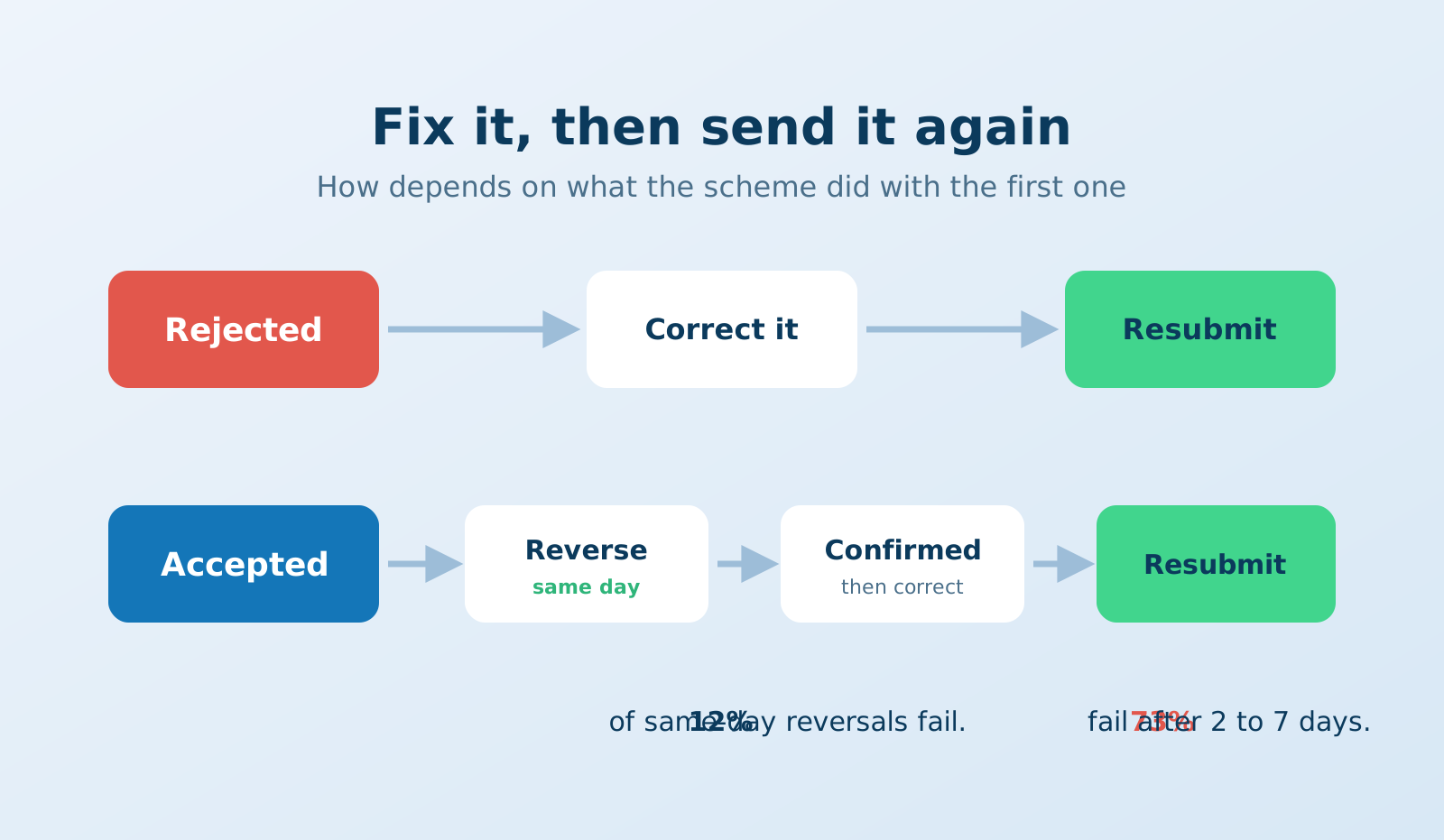
A claim has come back and you want the money. The fix is usually small - a code, a membership number, a date - but how you send it again depends on what the scheme did with the first one. Get that part wrong and a correct claim is rejected a second time, for a completely different reason, and the four-month clock keeps running while you work out why.
This is the practical sequence: what state the claim is in, what that lets you do, and the timing that decides whether a correction is two minutes of work or a phone call to the scheme. If you are still working out why it was rejected, start with why medical aid claims get rejected and, for code-level messages, medical aid claim codes explained.
First, find out which of three states the claim is in
Everything else follows from this. The words "rejected" and "resubmit" get used loosely, but schemes do not treat all returned claims the same way.
- Fully rejected. The scheme refused the whole claim. Nothing was paid and nothing is owed. There is nothing to undo.
- Accepted, fully or partly. The scheme has committed to paying at least some of it. Even if one line was refused, the claim as a whole is on the scheme's books.
- Paid to the member. The claim was accepted, but the scheme is paying the patient rather than you. This one is not a resubmission problem at all - see what "paid to member" means.
Your remittance advice or the scheme's electronic response tells you which one you have. Read the claim-level outcome, not just the line that caught your eye.
A rejected claim: correct it and send it again
This is the easy case. Because a rejected claim was never paid, sending a corrected version is simply a new submission. You can do it as many times as it takes.
- Read the reason literally. Scheme messages are terse but precise. A membership-number rejection means the number, not the diagnosis. A position number points at a specific slot on the claim.
- Fix the cause in the patient's record, not only on the claim. If the dependant code was wrong, correct it on the file, or the next visit is rejected for the same reason.
- Resubmit the same visit - same patient, same date of service, the corrected detail. Do not change the date of service to "today"; that is a different claim and a false one.
- Check the new response the same day. A second rejection for a new reason is common when the first fix exposed the next problem.
An accepted claim: reverse first, then resubmit
This is where most double rejections come from. Say a claim was accepted but you notice the wrong tariff code, or a missing line, or a price you need to correct. The instinct is to capture it again with the fix. Do not.
The scheme already holds an accepted claim for that patient, that account and that date of service. A second one is a duplicate, and it comes back with a message like DUPLICATE - ACCOUNT ALREADY PROCESSED. Nothing was wrong with your correction; the scheme is refusing to pay the same visit twice.
The right sequence is:
- Reverse the original claim - an electronic reversal tells the scheme to cancel it.
- Wait until the reversal is confirmed. A reversal that was sent is not a reversal that succeeded. If you resend before it is confirmed and it then fails, you have a duplicate.
- Submit the corrected claim.
This duplicate pattern is more common than it sounds. Across claims we process, over a single 30-day period we found 230 claims refused as already processed - and on roughly half of them, the original claim for the same visit had in fact been accepted. The practice had been paid, captured the visit again, and saw a rejection that looked like lost money but was not.
Timing decides whether a reversal works
Reversals are not equally easy at every point. Once a scheme has settled a claim in a payment run, many will no longer reverse it electronically. We measured the outcome of reversals by how long after the original claim they were sent, over 90 days of claims we process:
| Reversal sent | Failed |
|---|---|
| Same day as the claim | 12% |
| The next day | 45% |
| 2 to 7 days later | 73% |
| 8 days or more | about 70% |
The lesson is not subtle: a correction made while the patient's visit is still today is almost always electronic, and one made next week is usually a phone call. That is one of the strongest practical arguments for seeing each claim's response in real time rather than in a batch days later.
Two reversal messages worth knowing
- "Electronic reversal for this scheme not available. Please contact scheme for manual reversal." It reads as though the scheme cannot do electronic reversals. In our data it means the claim is too old: not one occurrence we measured came from a same-day reversal. Phone or email the scheme for a manual reversal.
- "Unable to complete transaction. Please resend." Despite the wording, this does not mean resend the claim. It means the reversal did not go through. The usual cause is that the scheme had sent the original for manual assessment: same-day reversals of normally processed claims failed about 9% of the time, and same-day reversals of claims under manual assessment failed about 93% of the time. Resending the claim now creates a duplicate. Ask the scheme to reverse it manually.
When you contact a scheme for a manual reversal, quote the authorisation or reference number from the original claim's response. It is the quickest way for them to find the exact claim.
The clock does not stop for a rejection
Schemes generally treat a claim as stale four months after the date of service. A rejection does not reset that clock. A claim rejected in week one and fixed in week one has almost four months of room. The same claim found in month four has days, and may already be a write-off.
So the most valuable habit is not a better fix, it is a faster look: check every response on the day it arrives, deal with rejections while the patient's file is still fresh, and reverse on the same day wherever a correction is needed.
Frequently asked questions
Should I phone the scheme or resubmit electronically?
Resubmit electronically wherever you can: it is faster and leaves a record. Phone when the claim needs a manual reversal, when a rejection reason makes no sense against what you sent, or when the same claim keeps coming back for a reason you have already fixed.
Can I resubmit only the rejected line?
Not by itself. A line that was refused on an otherwise accepted claim belongs to that claim. If the refused line is worth correcting, reverse the claim and resubmit the whole corrected claim, while it is still young enough to reverse.
The patient's details were wrong. Is it a new claim?
No - it is the same visit with corrected details. Fix the patient's record, then resubmit the same date of service. Correcting the record first stops the next visit failing for the same reason.
Every claim's response back in seconds, reversals sent the same day, and a resend that is refused until the reversal is confirmed. See how NetPractice handles medical aid claims →
Free under 11 claims a month. Start claiming →